Wednesday, May 27, 2009

Honda FC Sport


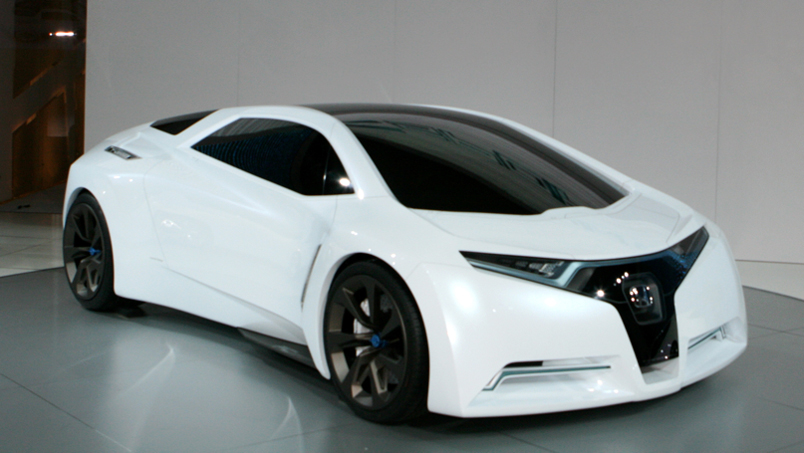
Honda today revealed the Honda FC Sport design study model, a hydrogen-powered, three-seat sports car concept, at the 2008 Los Angeles Auto Show.
The FC Sport emphasizes the design flexibility and potential of Honda's V Flow fuel cell technology - already deployed in the Honda FCX Clarity sedan - and reconfigures it into a lightweight sports car design with an ultra-low center of gravity, powerful electric motor performance and zero-emissions. The design study concept is inspired by supercar levels of performance through low weight and a high-performance, electrically driven fuel cell powertrain.
"The Honda FC Sport explores how to satisfy automotive performance enthusiasts in a world beyond petroleum," said Dan Bonawitz, vice president of American Honda Motor Co., Inc. "People who love sports cars will still have a reason to love in a hydrogen-powered future."
The high-output Honda fuel cell powertrain and a sleek, aerodynamic body contribute to the vehicle's performance potential. A modular approach to fuel cell component packaging and the electric drivetrain contribute to the FC Sport's low center of gravity with the majority of vehicle mass distributed between the axles, creating the balanced weight distribution sought after in sports cars.
The ideal placement of the Honda V-Flow fuel cell stack and related components demonstrates the benefits of a platform-specific, hydrogen-powered fuel cell powertrain. The FC Sport is configured to accommodate a custom-formed high-power fuel cell stack, located between the rear seats, and a battery pack placed low in the middle of the vehicle. The electric motor resides just forward of the rear axle. Two fuel storage tanks, visible from above, are located above the rear axle.
The optimal placement of fuel cell components for performance also allows for a relatively large passenger cabin by conventional supercar standards with enough space for three seating positions. The interior layout focuses primarily on the driver with a racecar-like center driving position. The enclosed canopy opens upward from the rear to allow for entry and exit. Two rear passenger seats flank the driver's left and right side.
The sleek, low-profile body is designed to convey a high-technology appearance with sculpting that combines angular shapes in the front of the vehicle that taper into geometric, hex forms in the rear. The rear hex forms house cooling radiators for the fuel cell. Formula 1-style barge boards behind the front wheels enhance high speed aerodynamics and convey the vehicle's racing pedigree. The hydrogen storage tanks, visible from the rear deck, showcase the FC Sports fuel cell technology in much the same way that a "naked bike" motorcycle showcases its engineering technology.
The glacier white body color conveys the FC Sport's clean environmental aspirations while the dark wheels and deeply tinted glass provide a symbolic contrast befitting of the vehicle's unique combination of clean power and high performance. Green construction techniques further contribute to a reduced carbon footprint. An organic, bio-structure theme is carried through to the body construction where exterior panels are intended to use plant-derived bio-plastics

Thursday, April 30, 2009

Ferrari 360


The Ferrari 360 was all-new in 1999 and offered in Modena coupe and Spider convertible body styles. They were powered by a mid-mounted 3.6-liter V8 that pumped out a raucous 400 horsepower at 8,500 rpm. Low-end power wasn't as plentiful with a "mere" 275 pound-feet at 4,750 rpm. The all-important 0-60-mph sprint was accomplished in a few ticks north of 4 seconds.
The standard transmission was a six-speed manual tied to a classic Italian gated shifter complete with chrome ball knob. Many Modenas and Spiders were ordered with the rather pricey F1 automated clutch manual gearbox that shifted via column-mounted shift paddles in a lightning-quick 150 milliseconds. Although we'd probably stick with the stick, the F1's adept ability at rev-matching downshifts and its automatic mode (admittedly not the smoothest system in the world) make it a good choice for both aggressive driving and commuting.

Ferrari have modified the exhaust exits on the side pods of the F60 chassis and to boost down force, they have redesigned the nose cone to be longer with a higher central section to increase the amount of air flow underneath. The team has also minimised drag with the addition of channeling vertical fin on the end plate to direct the air flow away from the front tyres. The rear view mirror mountings are attached to the lower section of the bodywork, which creates a vertical turning vane that was originally introduced by BMW Sauber in 2008.
Base: Maranello, Italy Team principal: Stefano DomenicaliMain drivers: Kimi Raikkonen and Felipe MassaEngine: Ferrari Type 056Chassis: F60Tyres: Bridgestone PotenzaDebut F1 season: 1950World Championship titles: 16Highest race finish: 1st (x209)Pole positions: 203Fastest lap times: 218. More Images...

Audi R8


Let me tell you about Audi's R8. For starters it's not a warmed over Lamborghini. Audi might own the Italian supercar maker, but happily it's decided not to just give the Gallardo some new clothes. The R8 is also pitched at a different sort of buyer, making direct comparisons pretty much worthless.The R8's low-slung nose sports a variation on Audi's now familiar trapezoid grille so you're left in no doubt as to who is responsible for this Tarmac-scrapping monster, but every other point of reference is new. Despite its silhouette, this is no pumped-up, adrenaline-fuelled TT. In reality it's much more than that.And with a mid-mounted engine, this is an Audi like no other. The company's even been kind enough to stick it under a clear cover so everyone can see it. What you'll be looking at is the firm's acclaimed 4.2-litre petrol V8 unit, which can also be found powering the A4-based RS4. In R8 guise it produces a healthy 420 horsepower at a heady 7,800rpm, and a considerable 430Nm from a more practical 4,500rpm.Naturally, being a performance Audi, it gets quattro four-wheel drive. But being a special performance Audi the bias is slightly towards the rear in a naughty, lets have some fun way. Completing the basics is a six-speed manual gearbox, complete with Ferrari-style gated shift. However, the optional R tronic 'box is worth a mention.
More important than the R8's outright performance, it doesn't feel intimidating to drive. You sit down low in the cabin, and quickly feel at home surrounded by familiar Audi switchgear, an elegant fascia housing a large colour display, the main instrument binnacle and a transmission tunnel separating you from your hopefully willing passenger.
More details on car and Prices...

Lamborghini Gallardo


All Lamborghini Gallardo models are built on an aluminum space frame, with aluminum extruded parts welded to cast aluminum joint sections, and an aluminum body structure with thermoplastic hang-on parts such as fenders and door skins. The Gallardo is plenty light, but the Superleggera goes even further. From the outside, the Superleggera is nearly identical to the standard Gallardo coupe, with the exception of the Superleggera logo on the lower portion of the doors. But the shape hides a whole menu of lightweight parts including a carbon fiber diffuser under the rear end of the Superleggera, a pair of carbon fiber mirror housings, a carbon fiber driveshaft to the rear wheels, a polymer rear window and engine cover instead of glass, carbon fiber intake manifold, lightweight exhaust manifolds, forged aluminum wheels, and titanium wheel nuts, to make the car as light as possible

Inside the cockpit, the Superleggera has shiny gray carbon fiber door panels, a carbon fiber dashboard panel and carbon fiber console in order to save weight and look sexy. The headliner and carpet also have special graphics.

The standard Superleggera seats for the rest of the world's customers are carbon fiber sports seats that are closer to racing seats than street seats, with fore-aft adjustment only; since they are one piece, the backrest portion can't be adjusted separately, and some drivers simply won't be comfortable in the scantly upholstered seats.

The seats, in turn, are equipped with racing-style four-point seat belts, which means donning and adjusting two separate shoulder belts that come through openings in the seatbacks. Once adjusted to the body and cinched tight, the belts allow very little movement, so it's a good idea to close the doors first, because you won't be able to reach them once belted.

BMW M3


Within the BMW M GmbH model range, the BMW M3 has always been that very special model living up in full to its motorsport heritage. Indeed, this already applied to the very first BMW M3 launched in 1986 and continued throughout the two subsequent model generations. And now this supremacy comes out once again most clearly in the 2007 version of the BMW M3.


Although the latest generation of the BMW M3 was based in its development on the new BMW M3 Coupe, the new high-performance model differs from the 'regular' coupe in terms of both looks and technical features. Apart from the load-bearing structure of the car, only the two doors, the bootlid, the windows, the headlights and rear lights have been carried over from the 3 Series Coupe. All other body components, by contrast, were specially developed for the new BMW M3.

The new heart of the latest BMW M3 is the eight-cylinder power unit that develops maximum output of 420 bhp (309 kW) hp from engine capacity of precisely 3,999 cc. Further equally impressive factors are the engine's peak torque of 295 lb-fts (400 Nm) as well as maximum engine speed of 8, 400 rpm. Power is transmitted to the rear wheels by a six-speed manual gearbox interacting with brand-new M differential lock. This setup accelerates the M3 to 100 km/h comes in just 4.8 seconds

A low-pressure version of BMW’s double-VANOS has been developed especially for the new eight-cylinder, reducing charge cycle losses and, in the process, improves engine output, torque and responsiveness, with an equally positive impact on both fuel economy and emissions. A separate throttle butterfly for each cylinder provides an immediate engine response.

In designing the interior, the specialists at BMW M have succeeded in offering the occupants maximum driving pleasure Double circular instruments with white illumination and red needles, the M leather steering wheel and the newly designed centre console all characterise the cockpit of the new BMW M3. The door cutout trim embellished by the characteristic M logo, the support for the driver's left foot made of brushed metal, the special design and colour of the inner door panels, as well as the trim strip made of high-quality, sophisticated materials exclusive to BMW M such as leather in carbon design or aluminium, all serve to underline the supreme and truly unique position of the new BMW M3.
More details..

BMW M5


BMW has announced details of the revised 5 Series Saloon and Touring range, topped off by the new BMW M5 Touring. Powered by the back-to-back International Engine of the Year-winning engine driving through BMW’s unique seven-speed Sequential Manual Gearbox, the new M5 Touring offers up to 1,650 litres of boot space for owners needing to move sizeable loads... quickly.
With the previous M5 Touring (E34) only available in left-hand drive, the arrival of the new M5 Touring marks the first time the high-performance estate has been offered to British customers. Powered by the same normally aspirated 5.0-litre V-10 cylinder engine as its Saloon counterpart, the new M5 Touring redlines at 8,250rpm. 507hp and 520Nm of torque propel the car from zero to 62mph in 4.8 seconds (only 0.1 seconds slower than the Saloon). Without the 155mph electronic limiter the new M5 Touring would be capable of achieving 200mph while still transporting the largest of loads.
These levels of performance are in part made possible by the world’s first seven-speed Sequential Manual Gearbox with Drivelogic in a production car. The gearbox features eleven different change patterns to offer the driver a personally-tuned driving expierience - six settings vary speed and response of gear change in a manual mode and there are five automatic modes. A Launch Control function delivers the fastest possible acceleration from standstill.
Like the Saloon, the new M5 Touring features a three-stage DSC+ traction control system. The default mode offers drivers high levels of performance and stability. M Dynamic Mode allows an enthusiastic driver the ability to push the M5 Touring to, and beyond, the absolute limits of traction, permitting some sideslip and countersteering before the system cuts in and is selected in the M Drive Manager (see below). If the DSC button is pressed, DSC+ is completely disengaged.
BMW M's variable M differential also offers the highest levels of driving stability and traction, especially when accelerating out of high-speed corners, with up to 100 per cent of drive being transferred to the rear wheel with most traction. Finally, the Electronic Damper Control (EDC) system offers three suspension settings to complement the prevailing driving conditions.
MDrive Manager packages these programmable settings, so that the touch of a single button sets the car up as required. Like a boy visiting his favourite sweet shop, the M5 driver can select his preferred settings for power, gearbox, EDC and DSC modes, Head-up Display and the degree of Active Seat bolster support, via the iDrive menu. One-touch of the M Drive button on the steering wheel then selects the desired combination and instantly changes the character of the car. One moment the M5 Touring is a placid and practical family car, the next it’s more akin to a track day special.More details..

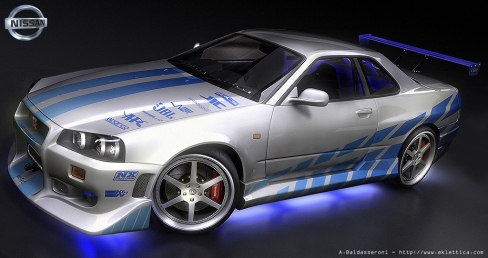
Nissan GTR


Motorsports is an important part of Nissan's strategy for building a strong brand with consumers who share our passion for high-performance driving," said Carlos Tavares, Executive Vice President, Nissan Motor Co. Ltd. "In addition to being an important touch-point for consumers, motorsports serve as a dynamic proving ground for automotive innovation."

SUPER GT

The R35 model Nissan GT-R will be entered in the GT500 class of SUPER GT. This year's entries will incorporate changes that include an improved air-cooling system and a paddle-shift transmission. The vehicles also conform to the racing body's latest regulation changes to decrease down force through shortened vehicle overhang. NISMO provides technical assistance and vehicle development to all participating teams.

Europe

To check the performance of cars to be sold to racing teams competing in the FIA-GT1 class, a NISMO-developed car will run as a non-championship entry in 4 races in 2009, entered in a team partnership with Gigawave MotorSport. It is expected that the car is to be driven by Michael Krumm (NISMO) and Darren Turner (Gigawave).
Gigawave MotorSport, a racing team based in county Essex, England, has been competing in the FIA GT Championship since 2007. The team's parent company Gigawave Ltd., as an official partner of the FIA GT Championship, provides on-board cameras for real-time coverage of the races.